
We can make a beginning by openly acknowledging the Russian help in 1971 victory when President Putin visits India on 6 December 2021. Showing gratitude to a friend is part of our DNA, notes Colonel Anil A Athale (retd).

Pak PM Imran Khan said the terror strike was an effort to 'sabotage' the country's economic projects

'It will be a repeated folly to ever think that China will not attack us.'
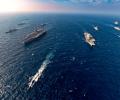
China's behaviour in the post-pandemic geopolitical landscape which may determine the Quad's future trajectory, notes former foreign secretary Shyam Saran.

Admiral Sam Locklear heads the US Pacific Command, making him the most powerful military commander on earth. With 60 per cent of the US Navy under him, PACOM oversees 52 per cent of the planet. Locklear is America's military pointsman for 36 countries, including India and China.
The first priority for the new Tibetan administration in Dharamsala should be to look at Tibetan recruitment in the PLA, suggests Claude Arpi.

The frontline warships include Rana, a Rajput class guided missile destroyer, Shivalik, a stealth frigate, Karmuk, a Kora class Corvettes and INS Shakti, a fleet tanker, comprising about 1400 sailors, and would berth at Shanghai's picturesque "Bund" to make a big splash

Chinese President Xi Jinping has stressed the need for the recruitment of new talent to support the rapid modernisation of the armed forces and win future wars amid reports that the military has committed more resources to enrol 3 lakh personnel for frontline positions.
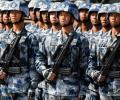
'This is the first time that active PLA army personnel would be reduced to below one million,' PLA Daily said.

The report claims that the military experts who have analysed the evidence collected by its Investigative Unit say an airstrip under construction in Agalega will almost certainly be used for maritime patrol missions by the Indian Navy.

The 50,000-metric tonne vessel will focus on what a genuine aircraft carrier is supposed to do like conducting combat-ready patrols and safeguarding China's maritime sovereignty and interests, the report said.

Defence and strategic experts on Monday said that China's posturing in the Indian Ocean will disturb stability and peace in the region.

'If you behave like a nail, the adversary will behave like a hammer.'

The bogey of the 1962 defeat must be laid to rest with a finality that is unquestionable. The myth of Chinese invincibility is a tall tale that belongs to an era gone by, says Vivek Gumaste.

India's decision to heed to Australia's request to be part of the mega naval drill comes in the midst of growing strain in ties with China over the border row in eastern Ladakh.

A US RC-135S reconnaissance aircraft on Wednesday flew near the ongoing Chinese People's Liberation Army (PLA) drills in the South China Sea, a day after another US spy plane, a U-2, trespassed into another PLA exercise restricted zone, state-run Global Times reported.

'Amid the frequent cries that the defence budget falls short of what is needed, we tend to ignore the reality that any enhancement in the allocation is just not possible, and the armed forces have no option but to operate within this constraint.' 'So, unless deadwood -- especially manpower -- is identified and eliminated, we simply cannot have a modern military of the type that India needs,' says Vice Admiral Premvir Das (retd).
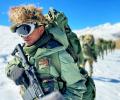
The United States will continue to support India with equipment and other things it needs along the Line of Actual Control (LAC) with China, a top American admiral has told lawmakers, asserting that Washington and New Delhi share a 'tremendous partnership'.

'India's specific concerns about whether Russia will be a reliable defense supplier and diplomatic partner in the event of heightened hostilities with China has undoubtedly accelerated the process of US-India defense and intelligence cooperation intended to support Indian military positions along the Line of Actual Control.'
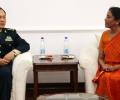
'In the case of an India-Pakistan confrontation, the Chinese may undertake more than just posturing, thereby constraining us from deploying adequate forces for decisive results,' warns Brigadier S K Chatterji (retd).

The aircraft carrier is China first domestically-built ship. Shandong is bigger than China's first aircraft carrier Liaoning and could house 36 fighter jets.

'Investment is the only way India can counter the Chinese influence in the region.' 'With more and more investments, you will have more and more stake; the strategic importance of Sri Lanka can be fulfilled with investments.' 'Investments should come because the void which is created by investments is always going to be filled by Chinese companies.'

'By causing military humiliation of India it intends to send a signal to other Asian countries to toe the Chinese line,' argues Colonel Anil A Athale (retd).

Top military officers, including Chief of Defence Staff General Bipin Rawat, had been summoned to make presentations on military uniforms.

By changing the nation's name from India to Bharat, would this landmass overnight lose the emotional and cultural linkage that had been built over generations, centuries and millennia, asks N Sathiya Moorthy.
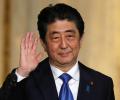
It is for the investigating agencies to probe all aspects of the assassination, including a possible Chinese hand, or if the killer was just a disgruntled element who acted on his own and wanted to earn some dark space in history like Nathuram Godse or Lee Harvey Oswald, notes Japan expert Rajaram Panda.

Should we not stop uncritically celebrating NRIs' elevation without regard to what kind of companies they are getting to run, and the nature of their products or business practices, asks T N Ninan.

An international tribunal in the Hague has ruled in favour of the Philippines.
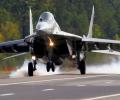
During the talks with the Russian leaders, the defence minister will also ask them to expedite the delivery of the S-400 air defence systems which are supposed to be delivered by the end of next year. The Russians had postponed the delivery schedule by several months due to delay in payments over certain issues.
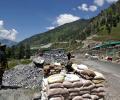
The meeting was attended by National Security Advisor Ajit Doval, Chief of Defence Staff General Bipin Rawat, Army Chief General M M Naravane, Navy Chief Admiral Karambir Singh and Indian Air Force Chief Air Chief Marshal R K S Bhadauria.

Three naval ships of China's Nanhai Fleet left a naval port in Sanya, Hainan Province on Wednesday, kicking off an annual combat drill in the South China Sea, East Indian Ocean and West Pacific, state-run Xinhua news agency reported.

"CCP's (Chinese Communist Party) territorial aggression is also apparent on its Indian border where China has attempted to seize control of the Line of Actual Control by force," US National Security Advisor Robert O'Brien said in a remark on China early this week in Utah.

"The message is clear. We're not going to stand by and let China or anyone else take the reins in terms of being the most powerful, dominant force, whether it's in that region or over here," White House Chief of Staff Mark Meadows told Fox News.

'Once positions are hardened and troops start building defences, it is difficult for soldiers to step back.'

The agreement would divert China's attention and keep them busy in the Pacific theatre, probably resulting in a reduction in threat perception in our area of interest in the Indian Ocean, notes Commodore Venugopal Menon (retd).

Expressing grave concern over a US nuclear-powered submarine sustaining damage in the disputed South China Sea, China on Friday demanded Washington to reveal the details and the location of the accident and blamed America's frequent air and naval sorties in the Indo-Pacific to assert the "freedom of navigation" as the "root cause" of the incident.
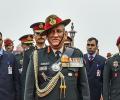
The creation of a CDS has got the head right. Issues that were not talked about for years are now being discussed, points out Ajai Shukla.

The PLA Air Force has conducted a combat air patrol in the South China Sea recently, which will become "a regular practice" in the future
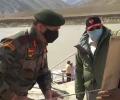
'We should not minimise the seriousness of Chinese encroachments because their perception is different.' 'Nor should we fall into the trap of accepting so-called 'buffer zones' in areas of overlapping claims. We cannot have buffer zones in our own territory,' asserts Ambassador Shyam Saran, a former foreign secretary.

Mere shuffling of resources or cosmetic changes to prove a point would be counterproductive in the long run, observes Commodore Venugoptal Menon (retd).
